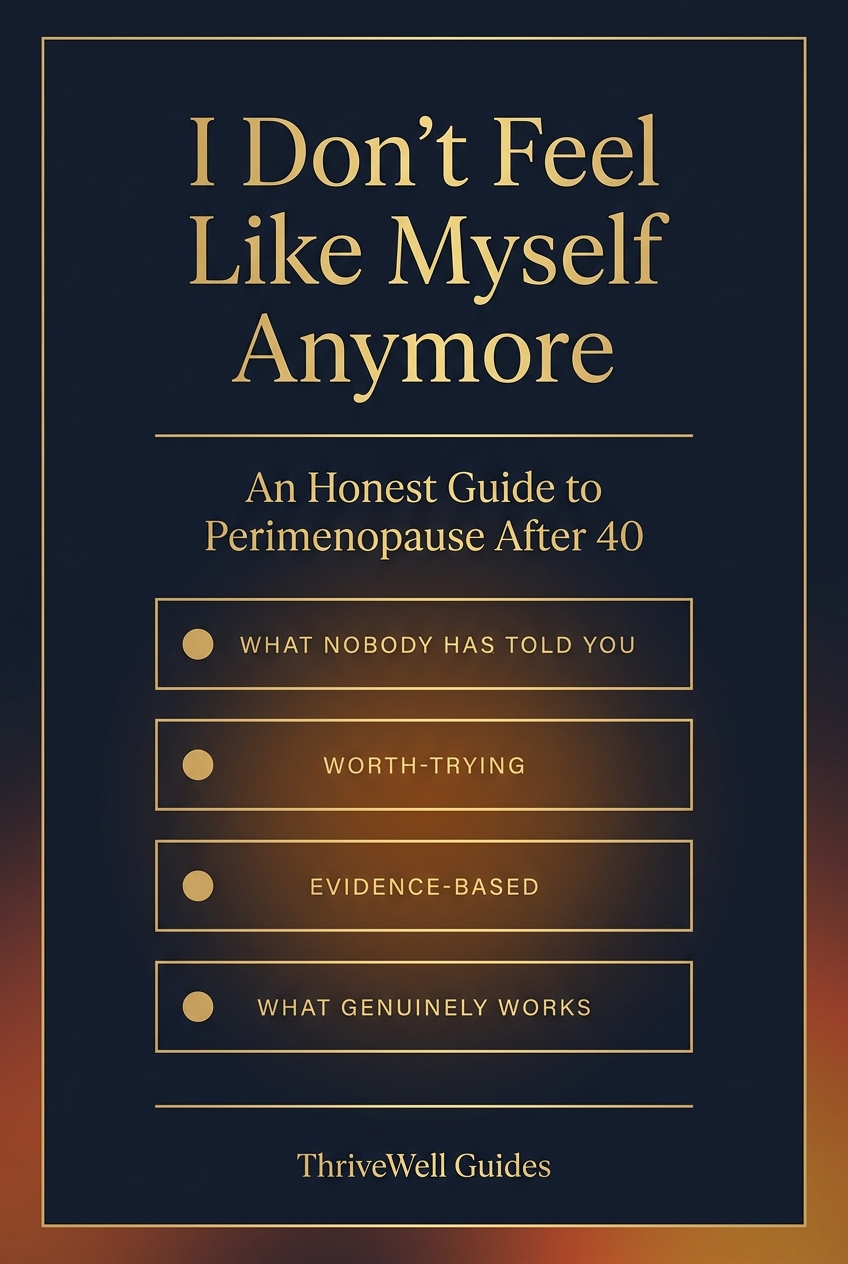
I Don't Feel Like Myself Anymore: An Honest Guide To Perimenopause After 40
What's actually happening, what genuinely works, and when to see a doctor.
The 3 am waking. The rage that frightened you. The word you couldn't find in a meeting. You've been told it's stress. It isn't. There's a name for what's happening to you — and once you know it, there's a great deal you can do about it. "You're not losing your mind. You're in perimenopause — and nobody told you what it actually looks like."
A guide that tells you the truth — including when the truth is inconvenient.
What You Need To Know
What Is Inside The Guide
The Symptom Decoder
The full picture, including the symptoms nobody warns you about. Build your Symptom Map and see the whole pattern in one place for the first time.
Is This Even Perimenopause?
The five conditions that mimic this almost exactly and the specific tests to ask for. Some are cheap, common and completely fixable.
How This Guide Rates Everything
The evidence system and three questions that will let you assess any health claim you meet for the rest of your life.
Sleep - Where the Biggest Win Lives
The treatment with the best evidence for insomnia, the one you've almost certainly never been offered, plus why standard sleep advice failed you.
The Rage, the Anxiety and the Fog
Why it's happening, what actually helps, and a clear line showing when this needs more than a guide.
Hot Flashes - The Honest Chapter
Two approaches with excellent evidence that nobody mentions. And the widely sold remedies that didn't survive review.
The Changes You Can't Feel - Muscle, Bone and Joints
The chapter you'll want to skip and the one that determines your next twenty years.
The Chapter Nobody Talks About - Intimate and Urinary Symptoms
The most under-treated part of this transition, including the link between recurrent UTIs and menopause that almost nobody explains.
Your Options, Explained Without Fear - Hormone Therapy and the Alternatives
What changed recently, what didn't, and how to decide without being pushed or frightened.
When to Stop Reading and Make the Call
The symptoms that are not this transition. Including several that are easy to file under "just menopause" and should never be.
The Appointment - How to Prepare, What to Bring, How to Open
And exactly what to say when you're told it's just your age.
Key Highlights and Protocols
- ✓The Symptom Decoder
- ✓The Partner & Family Explainer
- ✓Your Options, Explained Without Fear
- ✓When To Stop Reading and Make the Call
Additional Tools Plus More...
🎁 The Appointment Kit
Your personal factors sheet, test request card, question card and a one-page summary. Walk into a ten-minute appointment with a case instead of a complaint.
🎁 The Evidence Ratings Quick-Reference
Every strategy in the book, rated, on one page. Find out what you're currently wasting money on.
🎁 The Partner & Family Explainer
A single page you can hand to your husband, your grown children or your manager. Because you are too tired to explain this eleven times.
🎁 The Red Flag Card
The page I hope you never need. Designed for your phone.
WHAT THIS GUIDE ACTUALLY GIVES YOU
A name for it. The single biggest relief most women describe is not a treatment. It's understanding that this is a recognised transition with a mechanism, not evidence that they're falling apart. A pattern instead of chaos. The rage isn't random. The bad weeks aren't random. You'll be able to see what drives yours — and what's predictable can be planned for. The lookalikes ruled out. Some women reading this guide are exhausted because of something simple, common and treatable that has nothing to do with hormones. Finding that out is worth the price on its own. Sleep that starts moving in a fortnight. For most women, this is the fastest, largest improvement available — and it makes every other symptom easier to handle. Money not spent on things that don't work. The ⚠️ list is long, and expensive. Words for the appointment. Rehearsed sentences for the conversations that are hardest to start, including the ones about symptoms you've never said out loud. The end of "is this normal?" You'll know what's ordinary, what's worth watching, and what needs a doctor this week. One payment. Instant download. Yours permanently. For context: A single consultation with a menopause-informed specialist typically costs several times this, and most women don't know what to ask when they get there. This guide is what you bring with you.
Your name will be imprinted onto your personalized copy of the guide.
Your digital guide will be delivered directly to your email inbox immediately after purchase.
Refund Policy
I Don't Feel Like Myself Anymore* is a digital guide, delivered as a PDF download. If you've bought it and decided it isn't what you needed, you're entitled to a full refund within 30 days of purchase. Email **thrivewellguides@gmail.com** with the email address you used to buy the guide and the date of purchase. That's all. No form, no questionnaire, and no explanation required.
Frequently Asked Questions
Is this medical advice? — No, and it's careful to say so throughout. It's an educational guide that explains what's happening, sorts the evidence, and prepares you to have a much better conversation with a qualified professional. It does not diagnose or replace personalised medical care. Chapter 10 exists specifically to tell you when to stop reading and make an appointment. I'm 41 and still having regular periods. Am I too young for this? — Almost certainly not. Perimenopause typically begins in the mid-forties and can start earlier, and the symptoms belong to the transition — not to the point where periods stop. Many women are years away from their last period and already deep in the experience. Being told "you're too young" is one of the most common complaints women in their late thirties and forties report. Is this pro-hormone-therapy or against it? — Neither, deliberately. Chapter 9 explains what hormone therapy is, what genuinely changed in the guidance recently, what didn't change, and what to ask — and it treats deciding against it as a completely legitimate choice. Its job is accuracy, not persuasion. Everything else in the guide works regardless of what you decide. I've already been diagnosed. Is there anything here for me? — Yes - arguably more. Most women are given a diagnosis and very little else. Chapters 4 through 8 are practical management, and Chapter 9 will prepare you for a far better conversation at your next review. Can't I just find this online for free? — Some of it, yes. What's difficult to find is any of it sorted honestly — with popular remedies clearly marked as unsupported, and the well-evidenced approaches given the prominence they deserve rather than the prominence someone paid for. That sorting is what you're buying. How long is it, and how long will it take me? — Eleven chapters, with a Quick Win exercise in each that takes 10 to 25 minutes. You can read it in an evening, or work through one chapter a week. Chapter 1 gives you something useful in the first twenty-five minutes. What format is it? — A PDF you can read on your phone, tablet, laptop, or print. The tools are designed to be printed or photographed. What if it doesn't help me? — Send an email to thrivewellguides@gmail.com within 30 days, and you will be refunded in full — no explanation needed, and you can keep the file. To be clear about what that covers: it's a refund if the guide isn't useful to you, not a promise about your symptoms. No guide can honestly make that second promise, and this one doesn't try. Refunds are approved within **3 business days** of your email. Once approved, the money is returned via your original payment method. Depending on your bank or payment provider, it may take a further **5–10 business days** to appear in your account. Will you tell me my symptoms are all in my head? — No. That's roughly the opposite of the entire premise.